Target-Date Funds: Set-and-Forget Investing or Hidden Fee Trap?
A fund named for your retirement year feels automatic. The fine print decides if it saves or costs you.
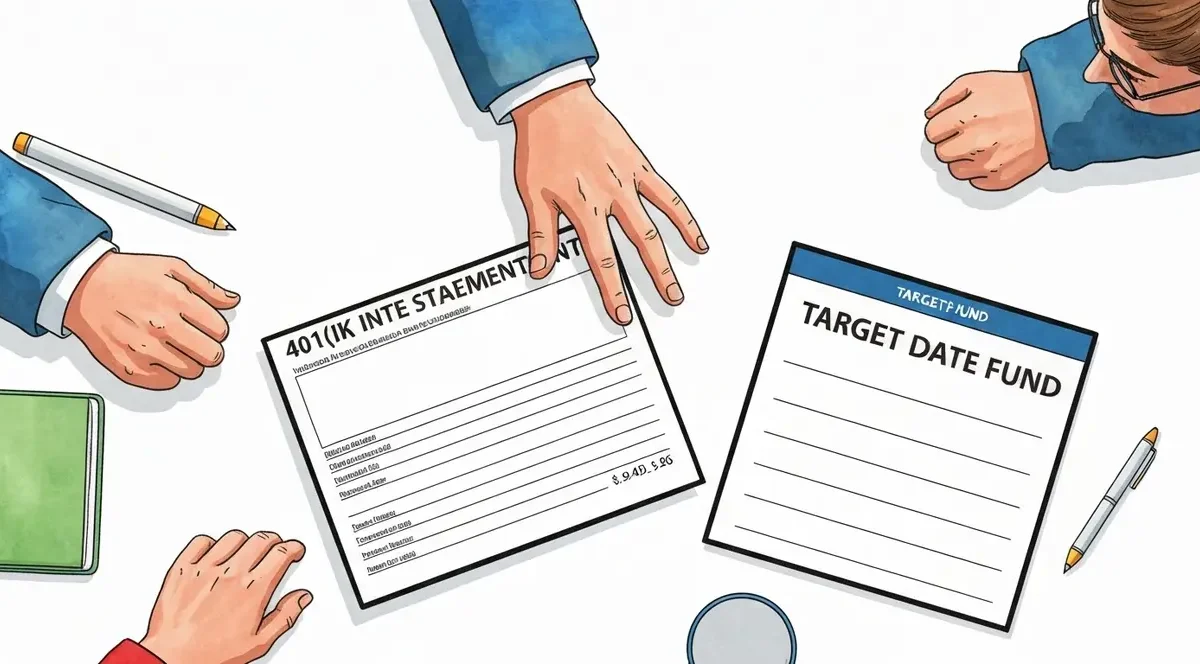
The software engineer making $180k, the pediatrician making $290k, the marketing director making $145k. All three opened their 401(k) statement last week, saw a fund called something like “Retirement 2055,” and felt vaguely confident they’d “picked an investment.” None of them could explain what a target-date fund actually does between today and the day they retire. That’s not a flaw in them. That’s the point of the product.
Target-date funds were engineered to be the answer for people who don’t want to think about asset allocation, rebalancing, or bond ladders. The question worth asking, before you let one run for the next 30 years, is whether the convenience is costing you money or saving you from yourself. The honest answer depends on which fund, which account, and which version of you is showing up to manage the portfolio.
Where target-date funds came from and why they exploded
The first target-date fund launched in the early 1990s, but the category didn’t take off until the Pension Protection Act of 2006 cleared the way for employers to use them as the default investment in 401(k) plans. Before that, if you enrolled in a 401(k) and never picked a fund, your money usually sat in a money-market account earning almost nothing. After 2006, plan sponsors could auto-enroll you into a target-date fund matched to your birth year. Suddenly, millions of workers were investing in equities for the first time without lifting a finger.
The growth has been steep. Target-date fund assets have grown more than 20% annualized over the past 15 years through the end of 2024, according to Morningstar. As of December 31, 2024, index-based target-date series hold 53% of all TDF assets, with active series at 42% and blended series at 5%. That shift toward index versions matters, because the cost gap between them is wider than most savers realize.
Here’s what changed the product’s appeal:
• Auto-enrollment defaults. Employers needed a single fund that worked for a 25-year-old and a 60-year-old. TDFs solved that.
• Glide path standardization. Providers published clear formulas showing how the stock/bond mix would shift over decades.
• Index versions arrived. Vanguard and Schwab cut expense ratios to 0.08%, putting them in the same neighborhood as DIY index portfolios.
• Behavioral protection. Investors who set and forget tend to outperform investors who panic-sell in a downturn.
That fourth point is the one people undervalue. The fund that prevents you from selling in March 2020 is worth more than the fund that’s three basis points cheaper.
The glide path: what’s actually happening inside the fund
A glide path is the schedule by which a target-date fund shifts your money from stocks to bonds as you age. Vanguard’s glide path, for example, starts at 90% equity for young investors and reaches a final allocation of roughly 30% stocks and 70% bonds at approximately age 72, according to Vanguard Workplace Solutions. Some providers start higher, at 95% equity or above, and some land more conservatively at retirement. Two funds with the same target year can hold very different portfolios on the same day.
The U.S. Department of Labor flags a distinction most savers have never heard: “to retirement” funds reach their most conservative allocation on the target date, while “through retirement” funds keep meaningful stock exposure for years afterward. If you plan to roll your 401(k) into an annuity at 65, a “through” fund leaves you with more equity risk than you bargained for. If you plan to draw down slowly over 30 years, a “to” fund may leave you under-invested in growth. Most people never check which version they own.
I’ve analyzed thousands of bank statements and 401(k) confirmations. Clear pattern: savers pick the fund whose name matches their expected retirement year and assume the rest is engineered correctly for them. The fund itself doesn’t know whether you’ll retire at 62 or 70, whether your spouse has a pension, or whether you’ll downsize. The glide path is a generic answer. It’s a good generic answer for most people. But it’s still generic.
Expense ratios: the gap between cheap and expensive is enormous
This is where the “hidden fee trap” framing earns its keep. Vanguard Target Retirement Funds carry an average expense ratio of 0.08% annually, which works out to 80 cents per $1,000 invested, as of December 31, 2025. Schwab Target Index Funds match that 0.08% rate and are built exclusively from ETFs, per data through March 2026. Meanwhile, the industry average expense ratio for comparable target-date funds excluding Vanguard sits at 0.41%, according to Vanguard and Morningstar data. That’s a fivefold cost gap for products that look identical from the outside.
Morningstar’s 2025 analysis quantifies the active-versus-index spread more precisely: active target-date fund portfolios carry expense ratios averaging 53 basis points higher than index-based portfolios, and blended portfolios run 32 basis points higher. On a $200,000 balance, paying 0.50% instead of 0.08% costs you $840 per year. Run that over 25 years with compounding, and you’re looking at meaningful dollars permanently removed from your retirement.
Before you sign anything, do the quick math: open your 401(k) plan documents and find the expense ratio for the target-date fund you’re in. If it’s at or under 0.15%, you’re in fine territory. If it’s between 0.15% and 0.40%, check whether your plan offers an index alternative. If it’s above 0.50%, you’re paying active management fees for what is often a fund-of-funds wrapper around index strategies anyway. That’s the part nobody wants to tell you.
Back-of-envelope: TDF versus a DIY 3-fund portfolio
The standard alternative to a target-date fund is the three-fund portfolio: a total US stock index, a total international stock index, and a total bond index. The case for DIY is usually built on cost, but the math is more interesting than the headline suggests. Using Vanguard’s lineup as the example, VTSAX carries a 0.04% expense ratio, VTIAX runs 0.11%, and VBTLX comes in at 0.05%. A 67% US, 20% international, 13% bond allocation gives you a weighted expense ratio of roughly 0.055%, per Bogleheads forum calculations.
That’s cheaper than the 0.08% Vanguard target-date fund. But the difference is 2.5 basis points, or $25 per year on $100,000. For that $25, the TDF handles automatic rebalancing across all three sleeves, shifts your allocation as you age, and removes the temptation to tinker. I’m gonna be straight with you: for most savers in a tax-advantaged account, the TDF wins the practical contest even when it loses the cost contest by a hair.
The DIY portfolio earns its keep in a specific situation: taxable brokerage accounts. Target-date funds are poor fits there because periodic internal rebalancing can trigger capital gains distributions you didn’t choose to take. A DIY three-fund setup lets you control rebalancing timing, harvest losses strategically, and place tax-inefficient holdings in your IRA while keeping stock indexes in the taxable account. That’s real money for high earners. For everyone else, the TDF inside the 401(k) or IRA is the better behavioral bet.
Who actually benefits from a target-date fund
The honest answer is: most people, in most 401(k) plans, most of the time. If you’re auto-enrolled at 28, contributing 10% with a company match, and you let a low-cost index target-date fund run for 35 years, you’ll likely beat the version of yourself who tried to manage allocations manually. The behavioral protection alone is worth the marginal cost.
The savers who should look elsewhere are the ones with specific reasons. If your plan only offers an actively managed target-date fund charging 0.60% or more, and you have access to lower-cost index funds in the same plan, building a manual three-fund mix can save real money over decades. If you have a taxable brokerage account, you almost certainly shouldn’t put a TDF there. If you have a meaningful pension or other guaranteed income coming in retirement, the generic glide path may be too conservative for your actual risk capacity.
Fidelity’s Freedom Fund glide path update from September 2025 is a useful reminder that these products evolve. Fidelity is increasing equity exposure for early-career investors and those already in retirement, and adding commodities to the strategic allocation. The transition started in Q4 2025 and is expected to complete by the end of Q1 2027. Whatever you own today may not be exactly what you own in two years. Check your fund’s prospectus annually.
From theory to your statement this month
If you remember one thing, remember this: the target-date fund is not a single product, it’s a category with a 5x cost spread and meaningfully different glide paths inside it. Two funds with the same year on the label can leave you in dramatically different financial positions at retirement. The choice isn’t TDF or no TDF. It’s which TDF, in which account, with which exit plan.
Three profiles, three plays:
• Auto-enrolled, under 40, plan offers index TDF at under 0.15%: stay put, raise contributions to capture full match plus 2%, ignore the statement for 12 months at a time.
• Plan only offers active TDF above 0.50%, but offers index funds individually: build a manual three-fund portfolio inside the 401(k), set a calendar reminder to rebalance every February.
• High earner with a taxable brokerage account also holding a TDF: move the TDF position into your IRA or 401(k), replace the taxable account with individual index ETFs to control gains distributions.
Back at the bank we called these the “label investors”: people who picked the fund because the name matched their birth year math, never opened the prospectus, and assumed the fund company had figured out everything for them. The label investors aren’t wrong to trust the structure. They’re wrong to assume all labels carry the same product underneath.
Two complications I see constantly. First, savers discover their plan’s TDF is expensive and panic-switch mid-year, triggering temporary cash positions during market rallies; the fix is to make the change at the start of a calendar quarter and move in one transaction, not a sequence. Second, people forget their TDF rebalances automatically and add a separate bond fund “for safety,” ending up far more conservative than they intended; pull up your statement and look at total bond exposure across all holdings, not just the line items.
This week, open your 401(k) portal, find the exact ticker symbol of your target-date fund, and look up two numbers: the expense ratio and the current equity percentage. Compare the expense ratio to the 0.08% Vanguard benchmark. Compare the equity percentage to where you actually want to be given your real retirement age, not the year on the fund’s name. If both numbers pass, you’re done for the year. If either fails, you have a 30-minute decision to make. Vanguard publishes its glide path details at Vanguard, and the Department of Labor’s fiduciary guidance on target-date funds lives at U.S. Department of Labor.